Home | Contact Us | People-Finder | A-Z Index

Main Image

Home


Summer Time is Research Time

07/11/2008

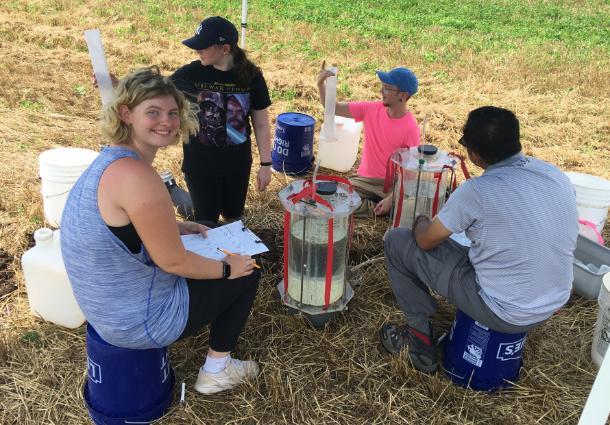
Several students have been working on an interdisciplinary water quality project during summer 2008.


Introductory Class which Sparks Students’ Interest into EGS

05/12/2008

Several undecided majors declared EGS as their major after taking the Physical Geology class.
The REASONS ……


Students studying sedimentary structure (ripple marks) to determine the paleocurrent (old stream flow direction) and the environment of deposition during the April 26th field trip for physical geology

Professor Vollmer and Chowdhury answering students’ questions regarding the presence of huge boulders at the “Hair Pin” Turn (Route 44/55)

Faculty-Student interaction beyond the classroom

Studying the Past Climate (Paleoclimate) to Evaluate Global Warming Trends

04/21/2008

The glacial sediments contain a record of deglaciation in the Champlain Valley which goes from till at the bottom to lake clays (Glacial Lake Vermont) to marine clays, silts, and sands (Champlain Sea). This study is conducted by carefully analyzing the lake and marine sediments for microfossils (ostracodes and foraminifera) as well as macrofossils (bits of plants, bugs, and bivalve shells) that can give us information about the paleo-environment. The research team will also be using the new EGS particle size analyzer on the sediments from these cores to track flood deposits and the slow shallowing of the Champlain Sea as it became modern Lake Champlain.


Amanda Lang (Geology) and David Jakim (EGS) working in the geomorphology lab (Dr. Rayburn’s Laboratory) on a core from the Champlain Valley


Previous EnvScience Stories